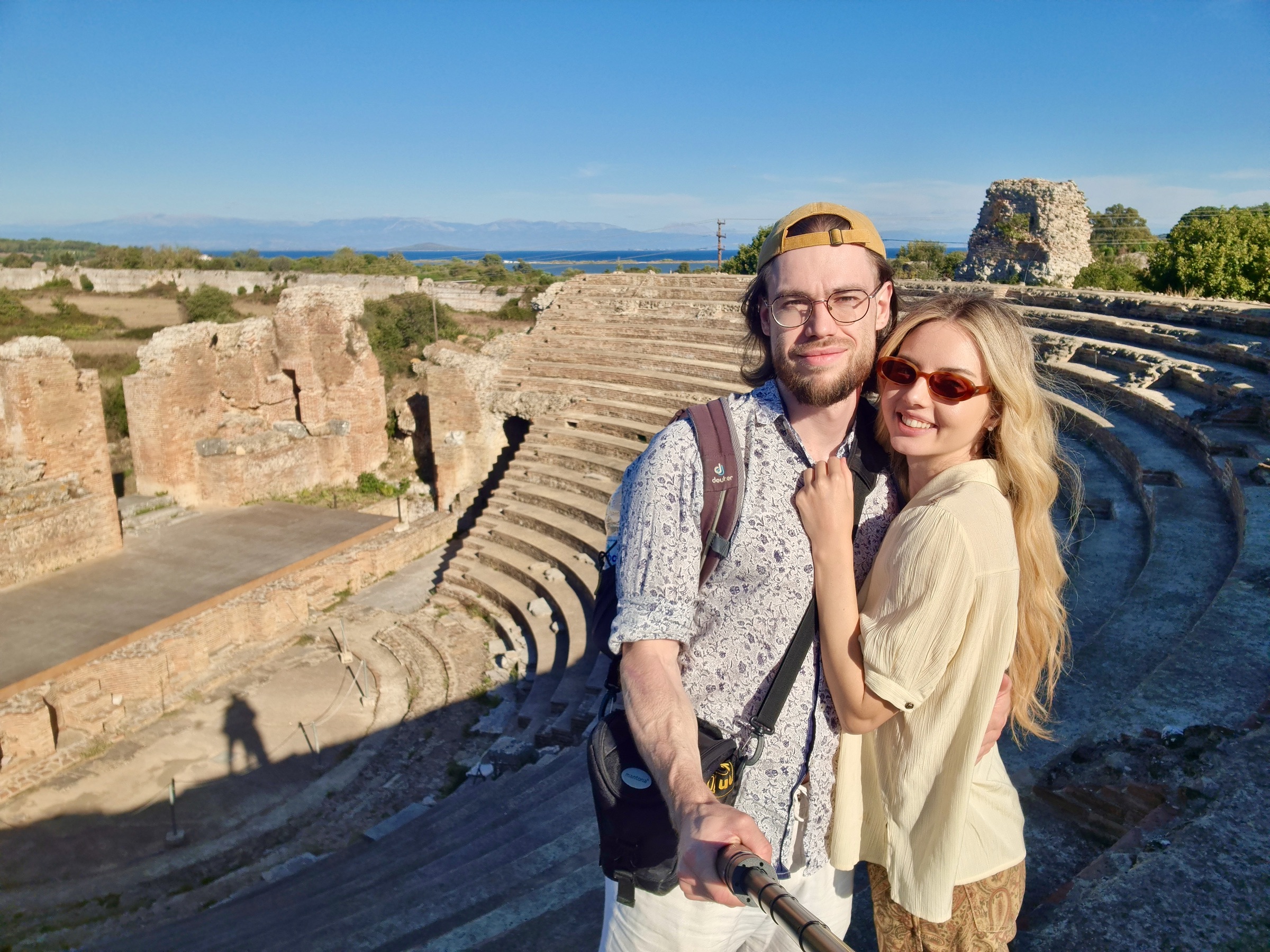
The oracle of the dead and the city of victory
Our second day trip from Ioannina went south-west towards the coast, to two places that are both, in their way, about the line between worlds: one about the dead, the other about power.
The Nekromanteion: a door to Hades?
Near the lower Acheron, one of the rivers of the underworld in Greek myth, a low hill is crowned by a small monastery of St John the Baptist. Beneath it, from 1958 onwards, the archaeologist Sotirios Dakaris uncovered a massive building with thick walls, winding corridors and a vaulted underground hall. He identified it as the Nekromanteion, the oracle of the dead, where visitors came to question the shades.
The most memorable story about the oracle comes from Herodotus. Periander, tyrant of Corinth, sent messengers to the oracle on the Acheron to ask his dead wife Melissa where a stranger’s deposit had been hidden. Her ghost refused to answer: she was cold and naked, she said, because the clothes buried with her had never been burned. To prove it was really her, she added a detail only Periander could understand, and it was a grim one.
Periander took the hint. He summoned all the women of Corinth to the temple of Hera in their finest clothes, had them stripped, and burned the clothes in a pit as an offering to Melissa. When he asked again, her ghost told him where the money was.
Scholars are much less certain today. Bronze fittings found in the building, which Dakaris thought were machinery for staging apparitions, were identified by the German scholar Dietwulf Baatz as parts of arrow-firing catapults, and many now read the complex as a fortified Hellenistic farmstead. Still worth the visit, just not necessarily for the ghosts.
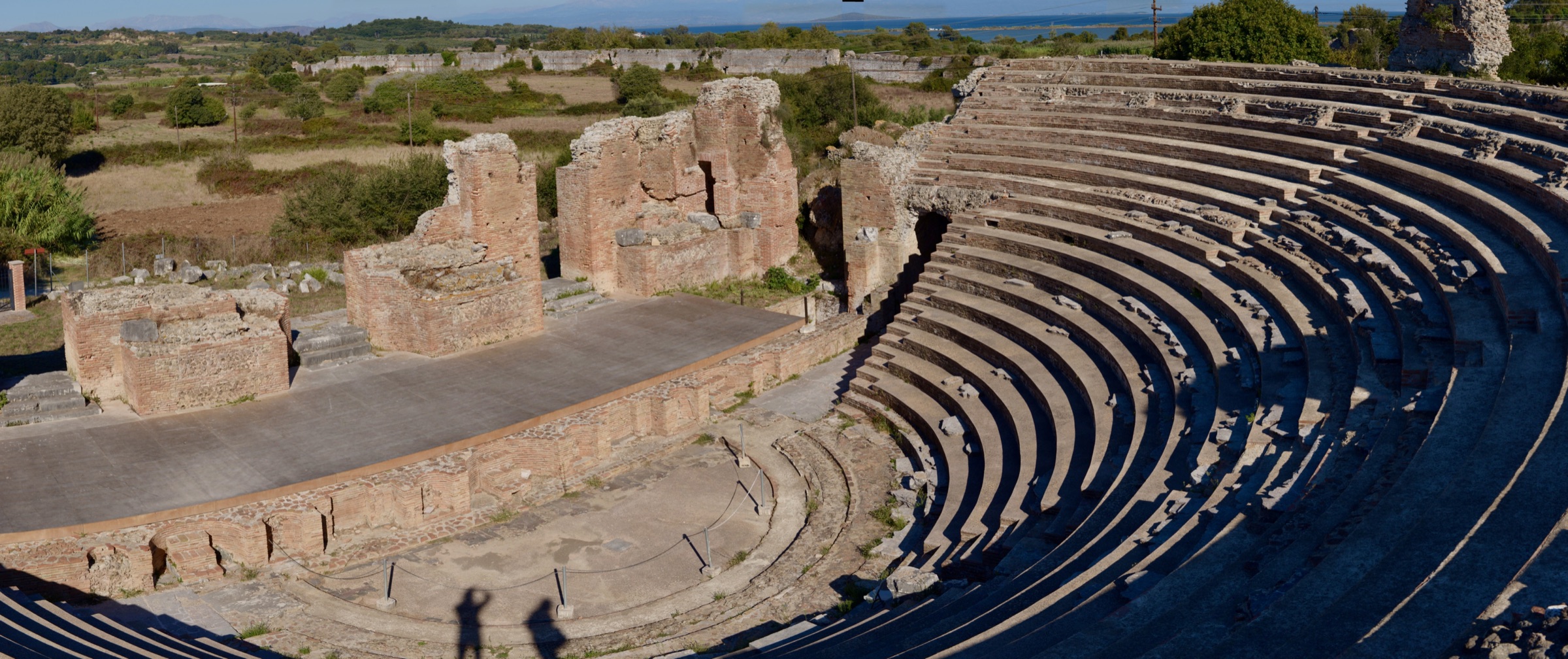
Nikopolis, the city of victory
On 2 September 31 BC, Octavian’s fleet defeated Mark Antony and Cleopatra off Actium, at the mouth of the Ambracian Gulf. Octavian, soon to be Augustus, founded a new city on the peninsula where his army had camped and named it Nikopolis, “city of victory”. People from the surrounding region were resettled there, and the Actian Games were held every four years.
Two later residents give the place an unexpected afterlife. The Apostle Paul wrote to Titus that he had decided to spend the winter in Nicopolis, very probably this one. And around AD 93, after Domitian banished the philosophers from Rome, the Stoic Epictetus moved here and opened a school. His student Arrian wrote down the lectures we still read as the Discourses.
Augustus’ campsite memorial
On the hill north of the city, where Octavian’s tent had stood, he built a victory monument dedicated to Neptune and Mars. Its front wall once held the bronze rams of captured enemy warships, more than thirty of them, each set into a socket cut to its own shape. The rams are long gone, but the sockets are still there, graded by size, and from them you can estimate how large the ships were.
Plutarch adds a lovely detail. On the morning of the battle Octavian met a man driving a donkey. Asked his name, the man said he was Eutychos, “Lucky”, and his donkey was called Nikon, “Victor”. After the battle, Octavian set up bronze statues of both man and donkey at the site.